New attacks widened GCC exposure beyond Hormuz, while prior energy and financing pressures strengthened
New aviation, shipping, regional-security and health pressures widened GCC exposure, while alternative routes kept oil moving and high US rates raised the cost of adaptation.
- Evidence reviewed
- 10 October 2026, 10:43 Dubai time
- Reading time
- 14 min read
The report separates immediate effects from second- and third-order consequences, then identifies the indicators that would change the assessment.
Bottom line: This week added a direct threat to Saudi aviation and new external pressure from the Black Sea, the Horn of Africa and cross-border disease. At the same time, the risks tracked last week mostly strengthened: alternative routes kept oil moving but concentrated more trade on fewer assets, while high US rates kept the cost of adaptation elevated.
Five conclusions define the GCC outlook this week
- Saudi airport attacks turned aviation from a theoretical exposure into an operating risk. The immediate disruption was contained, but repeated attacks would affect tourism, cargo, expatriate mobility and confidence before they stop hydrocarbon exports.
- New Black Sea, Tigray and Ebola developments add pressure through specific GCC channels, not one combined crisis. The channels are food and marine insurance, Red Sea and Horn security, and travel surveillance. None changes the GCC base case on its own.
- Alternative routes prevented an export shock but concentrated more traffic on Saudi, Emirati and Omani infrastructure. Visible Hormuz crude flow fell to at least 10.1 million barrels a day, while alternative-coast exports rose to 6.7 million barrels a day and kept total Middle East exports near pre-war levels.
- High US rates make new backup capacity more expensive before a GCC credit crisis has emerged. The US ten-year Treasury yield remained above 5%, but no common GCC banking-stress signal was identified by the cutoff.
- The GCC remains resilient, but outcomes will diverge according to route access, financial buffers and execution capacity. Saudi Arabia carries the widest operating exposure, the UAE and Oman benefit from routes outside Hormuz, and Bahrain is most sensitive to prolonged financing pressure.
New events this week widened GCC exposure through aviation, food routes, the Horn and health surveillance
1. Saudi airport attacks brought non-oil connectivity inside the regional conflict system
Attacks on Abha and Riyadh airports on 6–7 October killed three foreign residents and injured 36 people. A further attack on Riyadh airport on 8 October killed three Saudi citizens, including a pilot, and damaged a parked Saudia aircraft. The Houthis claimed responsibility for the 8 October attack; Saudi aviation authorities did not publicly attribute it. Operations resumed after a material but relatively short disruption.
- First order — airport damage interrupted passengers, cargo and aircraft operations. The immediate cost was localised disruption, casualties, damage and cancellations rather than a GCC-wide aviation shutdown.
- Second order — airlines, airports and insurers will increase protection and contingency costs. Repeated alerts can affect schedules, crew planning, war-risk cover and passenger confidence even when airports reopen quickly.
- Third order — repeated attacks would make aviation security a permanent cost of GCC diversification. Saudi Arabia, the UAE and Qatar rely on aviation, tourism and logistics as core non-oil growth engines. Persistent attack risk would require more redundancy, protection and restoration capacity.
GCC implication: The most important question is no longer whether the conflict can affect civil aviation; it is whether the attacks repeat often enough to change airline capacity, insurance or traveller behaviour. The assessment worsens with another verified airport attack, sustained airspace restrictions or a persistent rise in cancellations.
2. Black Sea vessel attacks widened GCC food and insurance exposure without creating a supply break
Three merchant vessels were attacked on 5–6 October in the Black Sea, including two in Bulgaria's exclusive economic zone. Vessel damage and rescue operations were confirmed; attribution remained unresolved. The incidents extend the Ukraine conflict's commercial-shipping risk beyond the immediate Ukrainian coastline.
- First order — crews, vessels and cargo were directly exposed. The incidents created physical loss and safety risk, but did not establish a broad interruption to grain exports.
- Second order — carriers and insurers may tighten route conditions or raise premiums. GCC importers could face higher landed food costs even if physical grain supply remains available.
- Third order — repeated attacks could make protected corridors and war-risk cover permanent features of Black Sea trade. That would shift the risk from individual incidents into a structural cost for import-dependent markets.
GCC implication: The near-term exposure is freight and insurance, not a general food shortage. The assessment changes if attacks continue and produce sustained rerouting, delayed grain deliveries or measurable GCC food-price pressure.
3. Tigray's control shift raised the risk of a wider Horn crisis without changing the GCC outlook
Control of Mekelle shifted to government-aligned forces. Reports of Eritrean entry and a drone attack increased concern about an interstate dimension, although full independent verification remained incomplete. Control of territory did not establish that flights, aid, banking and basic services were functioning normally.
- First order — political and military control changed while civilian access remained uncertain. Control alone does not show whether humanitarian and economic conditions improved.
- Second order — reported Eritrean involvement changes Ethiopian, Eritrean and regional calculations. It can make de-escalation more difficult and draw diplomatic attention away from implementation of the Pretoria agreement.
- Third order — a wider Ethiopia-Eritrea confrontation could add pressure near the Red Sea. This would matter to GCC security relationships, logistics and regional diplomacy rather than directly changing Gulf trade this week.
GCC implication: The event remains a medium regional-security watchpoint, not a driver of the GCC macro outlook. Verified interstate clashes, falling aid access or spillover toward Red Sea routes would strengthen the pathway.
4. Ebola's movement into Kenya raised the surveillance burden but left direct GCC risk low
The World Health Organization reported 8,728 confirmed cases and 4,205 deaths in the DRC outbreak. Contact follow-up was 80.4%, below the 85% target, and Kenya reported an imported case. WHO continued to assess global risk as low and did not recommend general travel or trade restrictions.
- First order — the imported case increased the need for travel history, referral and isolation capacity. An imported case is not the same as sustained local transmission.
- Second order — incomplete contact follow-up increases the cost of each cross-border case. GCC health systems may need stronger coordination with airlines and points of entry if importations increase.
- Third order — repeated importations could make border-health capability a more permanent function. The evidence does not support broad travel controls or a high direct GCC risk at present.
GCC implication: Maintain the event as a health-surveillance indicator rather than a leading economic risk. The assessment changes with sustained transmission outside the DRC and Uganda or secondary clusters linked to imported cases.
5. New AI power and materials commitments expanded a GCC opportunity, but delivery remains the test
TSMC reported September revenue growth of 54.6% year on year. Google and Constellation announced an agreement linked to 890 megawatts of nuclear uprates, with the first additional capacity expected in 2028. The European Commission selected 46 additional strategic raw-material projects, bringing its published total to 106.
- First order — investment is moving beyond chips into power and materials. Selected projects and contracted capacity are not yet operating assets.
- Second order — technology companies are becoming power, infrastructure and financing counterparties. Competition is widening from computing hardware into grids, cooling, sites and long-term energy supply.
- Third order — AI competition could become an industrial-system contest. Jurisdictions able to provide reliable power, capital, logistics and permitting can capture more of the value chain.
GCC implication: The opportunity is strongest where firm power, industrial sites, connectivity and finance can be delivered together. The risk is overbuilding before paid utilisation and project economics are established.
Prior pathways mostly strengthened; none of last week's main GCC calls reversed
| Prior assessment | New evidence this week | New direction | GCC meaning |
|---|---|---|---|
| Refined products were tighter than crude | EIA raised its diesel and Brent forecasts; the Russian diesel plan remained physically unverified | Strengthened | Higher prices can support exporters while logistics and customers still face tight delivered-fuel markets |
| Alternative routes offered capacity, not guaranteed delivery | Hormuz flow fell while alternative-coast exports preserved total Middle East volumes | Confirmed with a stronger buffer and greater concentration risk | Saudi, UAE and Omani infrastructure protected exports but now carries more of the system |
| Food pressure was regional rather than a global shortage | Central American losses and Black Sea risk increased; global cereal buffers remained adequate | Confirmed; regional landed-cost risk increased | The GCC exposure is price, freight and product dependence—not a general shortage call |
| Energy inflation and high yields could delay adaptation | Fed tightening expectations persisted; the US ten-year remained above 5% | Confirmed; broad project displacement remains unproven | Dollar-linked finance stays expensive while security and logistics needs rise |
| AI supplier demand was real but final utilisation was unresolved | Revenue, power contracting and raw-material projects expanded | Confirmed with wider physical scope | The GCC opportunity shifted further toward power, sites and infrastructure; final returns remain uncertain |
| Ukraine infrastructure reliability was deteriorating | Commercial vessels were struck beyond Ukraine's immediate waters | Worsened and broadened | GCC exposure widened from food prices into marine insurance and route reliability |
| Tigray control and civilian access were separate | Control shifted, but services lagged and reported Eritrean involvement raised regional risk | Divergence confirmed; downside increased | The watchpoint is a wider Horn and Red Sea problem, not control of Mekelle alone |
| Ebola depended on tracing and access | Cases rose, contact follow-up remained below target and Kenya imported a case | Worsened from a low GCC risk base | Surveillance needs increased; direct GCC health risk remains low without secondary transmission |
The two dominant prior pathways now point to more concentrated trade and more expensive adaptation
Alternative routes are preserving exports while creating new single points of failure
Visible crude flow through Hormuz fell to at least 10.1 million barrels a day—74% of its pre-war level and 27% below the previous week's wartime high. Gulf of Oman and Red Sea exports rose to 6.7 million barrels a day, more than twice pre-war levels. Total Middle East crude exports therefore remained near their pre-war level, according to shipping data reported by Reuters.
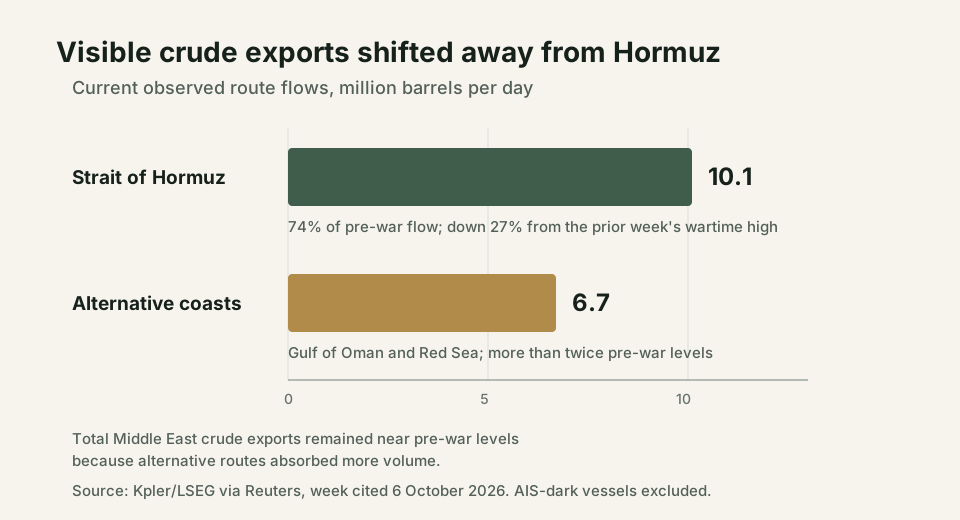
The new direction is clearer than last week:
- First order — the export system held because more oil moved through fewer routes. The 27% fall applies to visible Hormuz traffic, not total Middle East exports.
- Second order — rerouting shifted operating pressure to Saudi, UAE and Omani infrastructure. Pipelines, ports, storage, vessels and insurance are doing more work.
- Third order — persistent disruption would make backup routes permanent security infrastructure. The assets that provide redundancy are also becoming more important to protect.
The US Energy Information Administration estimates that the Saudi East-West pipeline and the UAE's Abu Dhabi pipeline can together bypass Hormuz with about 4.7 million barrels a day of design capacity. Design capacity is not usable throughput: storage, scheduling, crude quality, port space, insurance and security determine actual delivery.
High US rates are raising the cost of backup capacity before a GCC credit crisis has emerged
Federal Reserve minutes released on 7 October showed persistent inflation and an expectation among most participants that another rate rise would probably be appropriate by year-end. The official US ten-year Treasury yield ended at 5.24% on 9 October, compared with 5.28% on 2 October.
Five GCC currencies are pegged to the US dollar; Kuwait manages the dinar against a currency basket. The pegs support stability, but the five dollar-linked systems cannot easily maintain much looser monetary conditions than the United States.
- First order — borrowing remained expensive as new security investment became more urgent. High yields affect mortgages, corporate debt, infrastructure and project finance.
- Second order — public balance sheets can protect strategic projects, while private and lower-priority investment faces pressure. Saudi Arabia faces the largest investment choice; Bahrain has the greatest refinancing sensitivity.
- Third order — persistent pressure would widen the gap between GCC states and projects. Routes, financial buffers, leverage and execution capacity would determine which investments continue.
This is not yet a regional credit seizure. The Fed described credit as broadly available, and no common GCC banking-stress signal was identified by the cutoff. The pathway strengthens only if high yields coincide with slower GCC credit, tighter liquidity and verified project delays.
The combined GCC pathway runs from route and airport disruption into harder investment choices
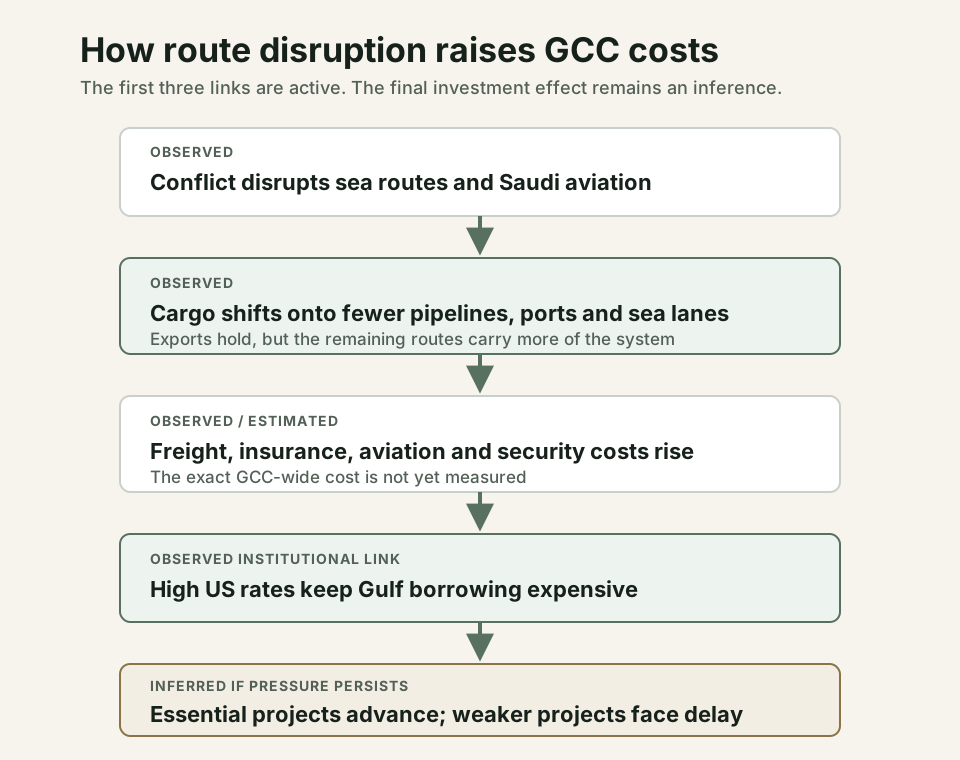
The route shift, airport exposure and dollar-rate link are active. The final step—delay or resizing of weaker projects—is an inference that still requires GCC credit and project-level evidence.
The global macro effect is higher delivered cost, not an immediate supply collapse
Rerouting kept total Middle East crude exports near pre-war levels, making the physical shock smaller than the Hormuz headline suggests. The same rerouting requires more transport, insurance, protection and finance, making the delivered-cost shock larger than aggregate export data suggest.
This keeps inflation pressure alive while high rates make new energy, transport and digital capacity more expensive. Energy-importing economies face the clearest purchasing-power loss. GCC exporters receive some price support but carry the route, aviation and non-oil costs directly.
A global recession or financial-crisis call would require wider confirmation: weaker employment and consumption, falling freight and industrial activity, wider corporate spreads, tighter bank lending and impaired funding markets. Those conditions were not present together at the cutoff.
The base case is continuity at higher cost; the downside begins if route and financing stress coincide
| Path | Conditions | GCC result |
|---|---|---|
| Base — trade continues at higher cost | Alternative routes stay open, airport disruption remains contained and US rates stay high | Hydrocarbon revenue is partly protected; logistics, aviation and finance weigh on non-oil activity |
| Easing — routes and finance improve together | Attacks fall, insured shipping rises, airport operations remain stable and yields ease | Trade costs decline and project delivery becomes easier |
| Downside — physical and financial pressure combine | Hormuz and Bab el-Mandeb deteriorate, aviation is repeatedly disrupted and funding remains expensive | Non-oil activity weakens, fiscal support rises and more projects are delayed or resized |
Saudi Arabia carries the widest operating exposure, while Bahrain remains most sensitive to financing pressure
- Saudi Arabia: The most direct mix of Gulf, Red Sea, aviation and large-project exposure. Its East-West pipeline, domestic scale and state capacity are strong buffers.
- United Arab Emirates: Fujairah and diversified ports provide an advantage outside Hormuz. Re-exports, tourism, property and wholesale finance remain sensitive to regional disruption.
- Oman: Sohar, Duqm and Salalah are becoming more strategically valuable. Imported inflation and global financing costs remain important constraints.
- Qatar: Large financial assets and long-term contracts provide protection. LNG facilities, Gulf shipping and airspace remain the critical physical exposures.
- Kuwait: Sovereign assets provide strong financial resilience. Gulf access, food imports, desalination and implementation speed remain the main constraints.
- Bahrain: Regional integration and GCC support are important buffers. Prolonged high rates and refinancing pressure create the greatest financial sensitivity.
Seven operating signals will show whether GCC resilience is holding or wider stress is emerging
| Risk | Where it stands | What would change the view | Next check |
|---|---|---|---|
| Hormuz and alternative routes | Hormuz at least 10.1 mb/d; alternatives 6.7 mb/d | Total exports fall for two weeks, an alternative route is impaired or insured capacity drops | Weekly shipping data |
| Saudi and GCC aviation | Riyadh attack caused deaths and aircraft damage; no GCC-wide shutdown | Another airport attack, material airspace restriction or sustained cancellation increase | Continuous authority and airline notices |
| Delivered fuel cost | EIA raised fourth-quarter Brent to $105/b; diesel remained tight | A further forecast rise with lower exports, or sustained fuel-cost easing without emergency support | Weekly; EIA on 10 November |
| GCC finance and projects | US ten-year at 5.24%; no common GCC stress signal | High yields plus slower credit, tighter liquidity and verified project delays in more than one state | Daily yields; national credit releases |
| Food and essential imports | No GCC availability disruption established | Product shortages, material stock drawdown or synchronised food-price acceleration | National CPI, customs and stock data |
| Black Sea and Horn access | Vessel attacks confirmed; Tigray normalisation unverified | Further attacks, sustained rerouting, verified interstate clash or weaker aid access | Continuous; UN and national updates |
| Ebola containment | 8,728 cases; contact follow-up at 80.4% | Two weeks above 700 cases or sustained spread outside DRC and Uganda | Next WHO update |
The outlook improves only if physical routes, aviation and financing conditions ease together
Stable exports alone will not remove the pressure if airports, insurance and borrowing costs stay high. Lower financing costs alone will not help if ports, pipelines or airspace become unreliable.
The next assessment will therefore turn on four tests: whether total exports remain stable, whether airports and airspace stay usable, whether GCC credit and project delivery weaken, and whether food and essential imports reach consumers without a sharp price increase.
The evidence base prioritises operating data and primary sources
- Reuters — Hormuz transits and alternative exports
- US EIA — October Short-Term Energy Outlook
- US EIA — World Oil Transit Chokepoints
- OPEC — 4 October production decision
- Saudi Press Agency — Abha and Riyadh airport attacks
- Associated Press — Riyadh airport attack
- Federal Reserve — September meeting minutes
- US Treasury — daily par-yield curve
- IMF — remarks to GCC finance ministers and central-bank governors
- Associated Press — Black Sea merchant shipping
- Associated Press — Mekelle and reported Eritrean entry
- WHO — Bundibugyo virus update, 8 October
- TSMC — September revenue
- Google and Constellation — nuclear agreement
- European Commission — Critical Raw Materials Act strategic projects