Oman's advantage is geography, and it has limits
Oman's main ports sit outside the Strait of Hormuz, so it grows while Qatar and Kuwait contract. Ten emerging risks to the GCC's quiet outperformer, ranked — starting with the one its own forecasters disagree about.
- Horizon
- Near term · 2026–2030
- Signal strength
- Medium-high · observed and scenario
- Decision lens
- Trade · Fiscal · Workforce
- Reading time
- 15 minutes
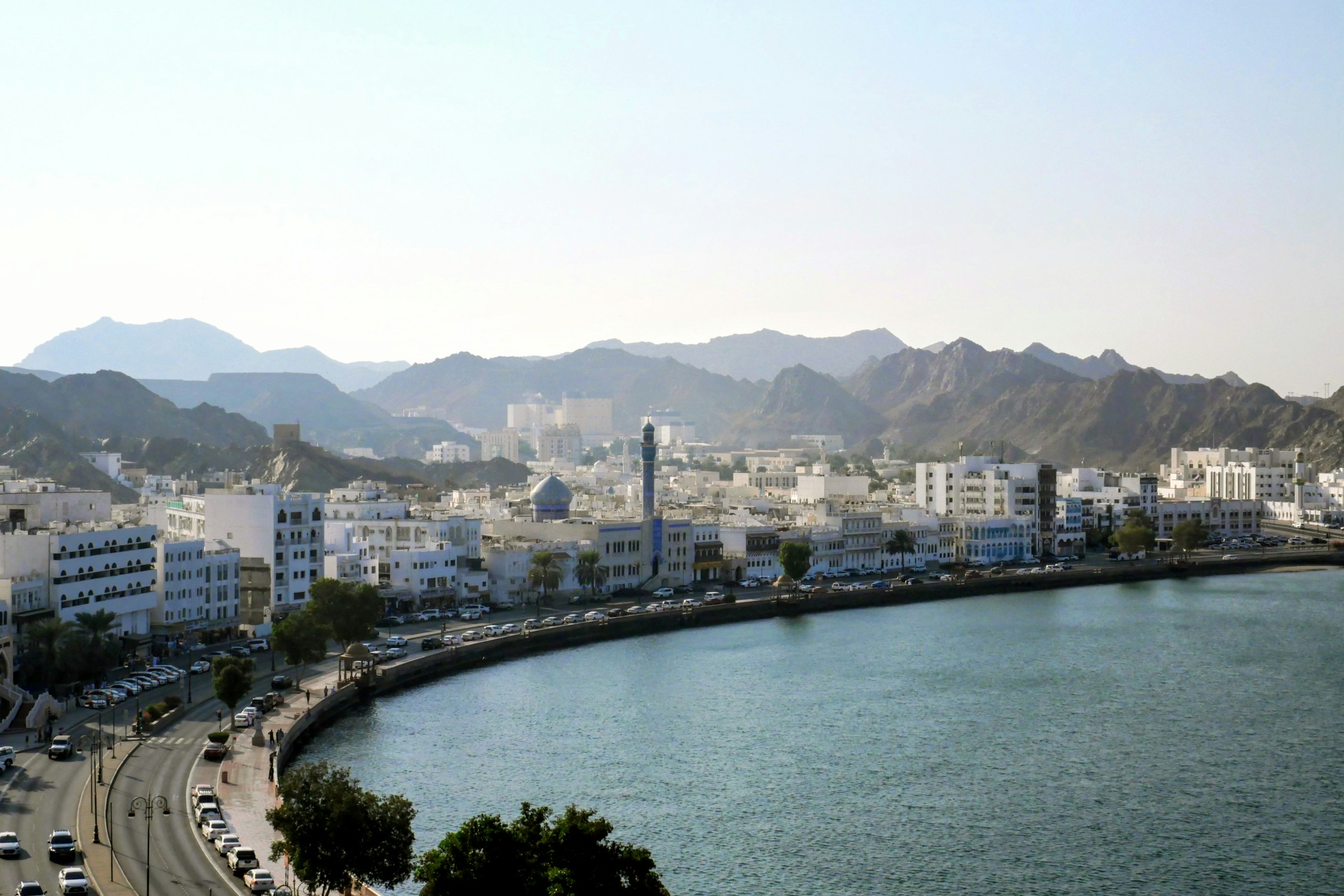
Oman’s geography is a real hedge. It is not a complete one.
Ports at Duqm and Salalah sit outside the Strait of Hormuz, giving Oman a routing advantage that has supported growth while more exposed Gulf economies face disruption. That is an operational advantage with measurable value, not a general immunity from regional risk.
Oil-price exposure, conflicting growth forecasts, slow workforce transition, and hydrogen projects that remain closer to pipeline than production still constrain the outlook. Geography protects cargo movement; it does not protect fiscal arithmetic, financing conditions, or investor confidence.
Public evidence brief5 cited findings behind the assessment
Question answered
What emerging risks could change Oman's fiscal position, and what would have to happen first?
This evidence layer is public and citable. The complete analysis, rankings, calculations, scenarios, and decision implications continue below.- Geography
- Oman · GCC · Arabian Sea · Strait of Hormuz
- Sectors
- Ports and logistics · Public finance · Energy transition · Workforce
- Risk classes
- Fiscal risk · Routing and trade risk · Execution risk · Transition risk
- Potential impact
- Moderate to high if temporary routing gains reverse while the higher fiscal breakeven proves correct
- Time horizon
- Near term · 2026–2030
Key findings and source trail
The evidence an outside reader can verify.
- 01
Oman's port geography is a measurable operating hedge.
Duqm, Salalah, and Sohar sit outside the Strait of Hormuz. World Bank reporting connects that geography with continued cargo movement and a positive 2026 growth forecast while more exposed regional peers contract.
- 02
Authoritative growth forecasts differ by 1.1 percentage points.
The World Bank places 2026 growth at 2.4%, while the IMF figure published through Oman's Ministry of Foreign Affairs is 3.5%. The evidence brief carries the range rather than creating a midpoint that neither institution published.
- 03
Debt improvement provides real resilience, but fiscal arithmetic remains oil-sensitive.
Oman's debt direction has improved materially, distinguishing it from more constrained Gulf sovereigns. The remaining uncertainty is whether the fiscal breakeven sits below or above the budget's $60 oil assumption, which changes the same price outcome from surplus to shortfall.
- 04
Vision 2040 targets are objectives, not a delivered pipeline.
The published vision targets oil and gas below 8.4% of GDP and non-oil revenue above 90% of government revenue by 2040. Their strategic importance is clear, but their long horizon means intermediate delivery evidence matters more than the endpoint alone.
- 05
Hydrogen potential becomes relevant only when projects cross investment and delivery gates.
The IEA identifies major renewable-hydrogen potential, while project and renewables targets establish the intended direction. The monitoring question is which projects reach firm investment, contracted offtake, grid connection, and production—not the aggregate ambition announced.
Risk transmission
How the exposure reaches the decision.
- 01
Ports outside Hormuz attract traffic diverted from more exposed Gulf routes.
- 02
Temporary trade gains support activity but do not remove oil-price exposure.
- 03
A reopening can reverse the routing premium while fiscal assumptions remain contested.
- 04
Hydrogen, renewables, and workforce targets then depend on financing and execution discipline.
- 05
The decision hinges on separating structural advantage from event-driven outperformance.
Entities and topics
- Duqm
- Salalah
- Sohar
- Oman Vision 2040
- Omanisation
- Green hydrogen
- World Bank
- IMF
Oman's main ports sit outside the Strait of Hormuz. Duqm and Salalah face the Arabian Sea, Sohar the Gulf of Oman, all of them beyond the chokepoint that closed in early 2026.
Per the World Bank, that infrastructure kept trade and cargo moving while regional peers were blockaded, and the numbers follow directly. Oman is forecast to grow 2.4% in 2026. Qatar is forecast to contract 5.7% and Kuwait 6.4%. Geography, not policy, is doing most of that work.
This is the exact inverse of Qatar's position. Not a bypass that was built at cost, but a coastline that was always there. Oman never had to decide to hedge Hormuz, because it was never fully behind it.
That makes Oman the most comfortable file in this series, and the most easily misread. Three things qualify the headline, and each of them is a risk below.
The advantage protects cargo, not price. Oman still sells hydrocarbons into a market priced by a chokepoint it does not use, so a regional escalation that moves the oil price reaches the Omani budget exactly as it reaches everyone else's.
The advantage may be temporary. A meaningful part of the 2026 outperformance is traffic diverted from blockaded neighbours, and diverted traffic has every reason to go back when the strait reopens.
And the most consequential number in the Omani picture is one nobody has settled. The 2026 budget was built on $60 oil. Oman's own published breakevens sit at $52–55 on one basis and $65.53 on another, one on either side of the government's assumption. Whether the budget balances is currently a question about methodology rather than about the oil price.
1. Where things stand
Growth, and the disagreement about it. The World Bank puts 2026 growth at 2.4% and the IMF at 3.5%. That is 1.1 percentage points apart, with the IMF figure 1.46 times the World Bank's, a spread of nearly half on a small base. Two authoritative institutions, no published reconciliation between them.
That gap is not a rounding difference. It is the difference between a recovery and a stall, and the honest treatment is to carry the range 2.4–3.5% and never take a midpoint, because a midpoint would be a number neither institution has published.
The budget and its unsettled breakeven. The 2026 budget was built on $60 a barrel. Published breakevens run $52–55 on one basis and $65.53 on another. At $60 Oman is comfortably above the low estimate and $5.53 below the high one. No source adjudicates between the two methodologies.
The genuine turnaround. Public debt is falling to around 33% of GDP. This is the strongest fact in Oman's file and it deserves emphasis, because it is the reason the country's position is materially better than it was five years ago, and it is what separates Oman from Bahrain, which carries a debt stock more than four times larger as a share of GDP.
Diversification that is actually happening. Non-oil grew 4.2% in 2025 against overall GDP of 2.8%. A non-oil economy growing faster than the whole economy is what real diversification looks like arithmetically, as distinct from diversification that is being targeted and announced. Oman is one of very few states in the region where that gap is positive.
Targets that are large and mostly distant. Per the Vision 2040 documents, oil and gas fall below 8.4% of GDP and non-oil rises above 90% of government revenues by 2040. Renewables are targeted at 30% of electricity by 2030. Those are fourteen-year and four-year horizons respectively, and neither should be read as a pipeline. Omanisation targets private-sector Omani employment rising from 11.6% in 2016 to 40% by 2040, a 3.45 times increase requiring about 1.18 percentage points every year for twenty-four years.
2. The ten emerging risks
Ranked by how much damage the event would do. Oman's register is unusually concentrated: one unresolved number decides several of the others. That is genuinely good news for anyone assessing the country, because it means a single published reconciliation would remove more uncertainty here than any disclosure in the rest of this series.
2.1 The budget misses because the higher breakeven is the right one
Oman built its 2026 budget on $60 oil. Its own published breakevens sit at $52–55 and $65.53. Oman can be entirely right about where oil trades and still miss its budget, depending on which methodology holds.
This is a rare shape for a risk and it is worth being precise about. It is not a question about the oil price. It is a question about what number the oil price has to beat, and the two candidate answers sit on opposite sides of the government's own working assumption.
Methodology differences of this kind usually come down to what gets counted as committed spending and over what horizon: whether state-owned enterprise obligations are included, how capital programmes are treated, what is assumed about production volumes. Neither published figure shows its working in a way that lets an outside reader choose between them.
The gap is also too wide to split. Averaging $52–55 and $65.53 would produce a third number that no institution has published and no methodology supports, which is a worse answer than carrying both.
No source found adjudicates. This is the single most consequential unresolved figure in the Omani picture, and one published reconciliation would settle it, along with two of the risks below.
2.2 The routing premium reverses when the strait reopens
Oman's 2026 outperformance is substantially a diversion effect. Cargo and confidence moved to ports outside Hormuz because the ports inside it were blockaded. When the strait reopens, that traffic has every commercial reason to go back.
The World Bank's credit to Omani port infrastructure is deserved, and the infrastructure is permanent. The traffic currently using it is not.
Diversion economics are well understood from other disruptions and they are usually temporary. Shippers route around a closure and return when the shorter, cheaper path reopens, unless something durable changed during the interval. A long-term contract signed at Duqm, a facility investment, a relationship that outlasts the emergency. Some of that happens in every disruption. Most of the volume goes home.
The risk is in how the 2026 growth figure is being read rather than in the reversal itself. A number driven substantially by diversion is not evidence of structural gain, and treating it as a new baseline would overstate Oman's underlying trajectory, which matters for anyone sizing an investment against it.
No source found separates the diversion component from underlying growth. That calculation is the one that would settle this, and it is not difficult to do with port-level data that Oman holds.
2.3 Regional contagion raises Oman's cost of capital
Oman's ports work and its neighbours' do not. But its borrowing costs are set by investors, insurers and shippers who price the Gulf partly as a single region, so the hedge that protects its cargo may not protect its financing.
The geographic advantage is real and it is the best structural fact Oman possesses. The limit is that confidence does not read maps carefully.
Insurance rates, shipping premiums and sovereign spreads across a region tend to move together during a regional conflict, because the people setting them are managing regional exposure rather than country-by-country exposure. A state that has done nothing to earn the repricing receives it anyway.
This is the mechanism by which Oman's advantage fails to convert into money. It protects the physical flow of goods, which is genuinely valuable and has kept the economy growing, and it does not protect the cost of capital, which is what determines whether the debt improvement in the fourth risk below continues.
No source found quantifies this for Oman specifically, which is why it sits here rather than higher. We include it because the alternative assumption, that a geographic hedge translates directly into a financing advantage, is equally untested and considerably more comfortable.
2.4 The debt improvement reverses
Debt falling to around 33% of GDP is the strongest fact in Oman's favour, and it assumes a budget that balances. If the breakeven question resolves badly, this is where it becomes visible.
The improvement is real and it has been earned over several years of consolidation. It is also the metric that most shapes how Oman is perceived, the thing that separates it from Bahrain in every comparison an investor will run.
That perception is doing a great deal of work. An improving debt path buys tolerance for a lot else, and the tolerance is priced into spreads today on the strength of a trajectory rather than a level. Oman's absolute debt position is unremarkable; its direction of travel is what is being rewarded.
Trajectories reverse faster than levels do, and they reverse in a way markets react to disproportionately, because the reversal invalidates the story rather than just the number.
We rank this fourth rather than higher because it is a consequence rather than a cause. It is listed separately because the failure would become visible before its cause did. Investors will see the debt ratio turn well before anyone publishes a resolution to the methodology dispute.
2.5 Oil falls below even the low breakeven estimate
At $52–55, the low estimate leaves Oman genuine headroom against a $60 budget assumption. A sustained move below that range removes the argument entirely, and no methodology dispute protects against it.
The breakeven disagreement only matters within a band. Below the bottom of that band, Oman runs a deficit on any reading, and the analytical question that dominates the top of this list simply stops applying.
This is the scenario in which Oman's geographic advantage is least useful, and it is worth understanding why. Ports outside Hormuz keep cargo moving. They do nothing whatsoever about the price of the hydrocarbons inside that cargo. A regional escalation that moves the oil price down reaches Oman's budget exactly as it reaches Kuwait's, and the coastline provides no insulation at all.
It ranks fifth because it requires a larger move than the methodology question does, and because the same event would be damaging the entire region rather than Oman specifically, which is, at least, a shared problem rather than an isolated one.
2.6 Omanisation misses invisibly
Omanisation needs about 1.18 percentage points a year, every year, for twenty-four years. Only the 2016 base and the 2040 target were found. With no intermediate series, the programme cannot fail visibly. It fails invisibly for years and then completely.
The obstacle is not stated as policy failure and should not be characterised that way. It is incentive, and it is structural. Expatriate labour remains cheaper and is often more experienced in specific technical roles, so private employers have a standing reason to comply with quotas nominally rather than substantively. Nominal compliance is very difficult to detect from outside.
Now combine that with the missing data, and the failure mode becomes unusual. Nobody outside government can say whether Omanisation is ahead of schedule, behind it, or flat, a decade into a twenty-four-year programme.
A commitment that cannot be measured cannot fail visibly. It fails quietly for years while the required annual increment grows, and it becomes undeniable only at the point where the remaining increment is arithmetically impossible. That is a much worse failure mode than a visible miss, because there is no moment at which anyone is forced to correct course.
Whether the target is achievable is our judgement rather than a sourced finding. What is not a judgement is the arithmetic: 1.18 points a year sustained for twenty-four years is a rate no Gulf state has demonstrated.
2.7 The hydrogen programme slips or is rescoped
Hyport Duqm Phase 1 was targeted for start-up in 2026 and MARSA LNG is described as the region's first LNG bunkering facility. No delivered-capacity figure was found for either. Both should currently be read as announcements.
This is the same announced-versus-delivered discipline that dominates the Gulf's AI build-out, appearing here in hydrogen. The instruction does not change with the technology: count what is running.
Hydrogen carries an additional problem that compute does not. Green hydrogen projects worldwide have a poor record of converting announcement into final investment decision, and a worse one of converting a final investment decision into delivered tonnes, because the offtake markets are still forming and buyers are reluctant to sign long-term contracts for a product with no established price. A slip here is not unusual. It is close to the base rate for the sector globally.
The consequence for Oman is timing rather than solvency. The 2040 targets are distant enough that a hydrogen delay does not threaten the budget in any near-term sense. What it threatens is the credibility of the diversification programme, a slower and more expensive kind of damage, because credibility is what determines the cost of capital for everything that comes after.
2.8 The 2030 renewables target is missed
Renewables are targeted at 30% of electricity by 2030. It is the only Vision 2040 objective close enough to be checked, which makes it the first real test of whether the programme delivers anything.
Everything else in Vision 2040 sits fourteen years out and cannot be assessed by anyone making a decision today. This target is four years away, which means it will produce an answer inside the horizon of current investors, lenders and rating analysts.
That makes it considerably more consequential than its size suggests. A missed 2030 renewables target would be the first hard evidence about delivery against a programme that has so far been assessed almost entirely on intention, and evidence about delivery reprices every more distant target at once, because it is the only data point anyone has about execution.
No published intermediate figure was found for progress toward the 30%. As with Omanisation, the absence of a series turns a checkable target into an unwatchable one, and that pattern is the subject of the last risk on this list.
2.9 Non-oil growth decelerates to the headline rate
Non-oil grew 4.2% in 2025 against overall GDP of 2.8%. That gap is the arithmetic signature of real diversification. If it closes, the diversification story loses its only quantitative support.
This is the most encouraging number in Oman's file and it is rarely examined closely. A non-oil economy growing faster than the whole is what diversification looks like when it is actually occurring, rather than when it is being targeted. Most states in this series cannot show it.
The risk is that part of the gap is cyclical rather than structural. Some of the 2025 and 2026 non-oil growth is downstream of regional disruption pushing activity toward Omani ports, logistics and services, which is the same diversion effect as the second risk on this list, showing up in a different statistic.
Strip that component out and the underlying non-oil rate may sit much closer to the headline. The diversification would still be real; it would simply be slower than the published figures currently suggest, on a target measured in decades.
No source found decomposes non-oil growth into structural and cyclical components. Until one does, the strongest single piece of evidence for Omani diversification carries an unmeasured temporary element.
2.10 Vision 2040's distance becomes a reason not to measure it
Oil and gas below 8.4% of GDP and non-oil above 90% of revenues are 2040 objectives. Fourteen-year targets with no published intermediate series cannot be held to account inside any investment horizon.
The pattern is already visible twice in this article. Omanisation has a base year and a target and nothing in between. Renewables have a 2030 number and no published progress against it. In both cases the effect is the same: a target that cannot be tracked cannot be missed until the deadline.
The event here is not the failure of the targets themselves. It is the absence of the reporting that would let anyone detect a failure early, extending from those two programmes to the fiscal objectives as well, so that the entire Vision 2040 framework becomes unfalsifiable until it is far too late to correct.
This is our reading rather than a documented development, and it ranks last because it is the least concrete item here. We include it because two of the risks above are already instances of it, which suggests a pattern in how the programme reports rather than an oversight in two places.
The remedy is unusually cheap, which is worth saying. Publishing an annual Omanisation figure and an annual renewables share would cost very little and would convert two of these risks from unwatchable to watchable.
3. What this means
One unresolved number decides several of these risks. The breakeven question sets the debt trajectory directly and colours everything about the fiscal path. Oman's register is unusually concentrated, and a single published reconciliation would remove more uncertainty than any other disclosure in this series.
The geographic hedge is real and it is not financial. Oman is the only Gulf state whose ports kept working, and the third risk on this list is the reason that has not translated into cheaper borrowing. A hedge the market prices as a bloc is not a hedge the market pays you for.
Almost nothing here is checkable soon. Vision 2040 is fourteen years out, Omanisation has no intermediate series, hydrogen has no delivered figure. The 2030 renewables target is the first hard checkpoint, which makes it considerably more informative than its size suggests.
What to watch. Three things would move this assessment: a published reconciliation of the two breakeven estimates, any intermediate Omanisation figure, and a delivered-capacity number for Hyport Duqm. All three are absences rather than forecasts, which is the defining feature of the Omani file.
Sources
- authoritative · World Bank via Oman Observer — Oman economy to grow 2.4% in 2026 — the 2.4% forecast, the port advantage during the blockade, and the Qatar and Kuwait contraction figures
- authoritative · IMF via Oman Ministry of Foreign Affairs — the 3.5% forecast. ⚠ disagrees with the World Bank by 1.1pp for the same year, with no published reconciliation
- authoritative · IEA — Oman's renewable hydrogen potential — the hydrogen programme
- researched · Zawya — Oman economy to grow 2.4% in 2026 — independent corroboration
- researched · Oman Vision 2040 — Economy and Development pillar — the 8.4% and 90% targets. ⚠ 2040 objectives, not pipeline
- researched · Green Hydrogen Organisation — Oman — Hyport Duqm and the 30%-renewables-by-2030 target
- researched · Allianz Trade — Oman country report — fiscal and debt framing
- scaffold · In-session arithmetic — the 1.46× forecast divergence, the $5.53 breakeven gap, and the 3.45× / 1.18pp-per-year Omanisation figures. ⚠ not an external source; the readings in §2.4, §2.8 and §2.9 are ours, not any source's
Continue the thread
Get the next material change, not the next headline.
Receive new UFOQ briefings and concise signal updates when the evidence changes enough to matter.