Qatar's biggest risk cannot be piped around
Saudi Arabia routed its crude around a closed Strait of Hormuz. Qatar cannot, because LNG does not travel overland. Ten emerging risks to the strongest balance sheet in the Gulf, ranked by severity.
- Horizon
- Immediate · 2026–2028
- Signal strength
- High · observed and scenario
- Decision lens
- Energy · Trade · Fiscal
- Reading time
- 17 minutes
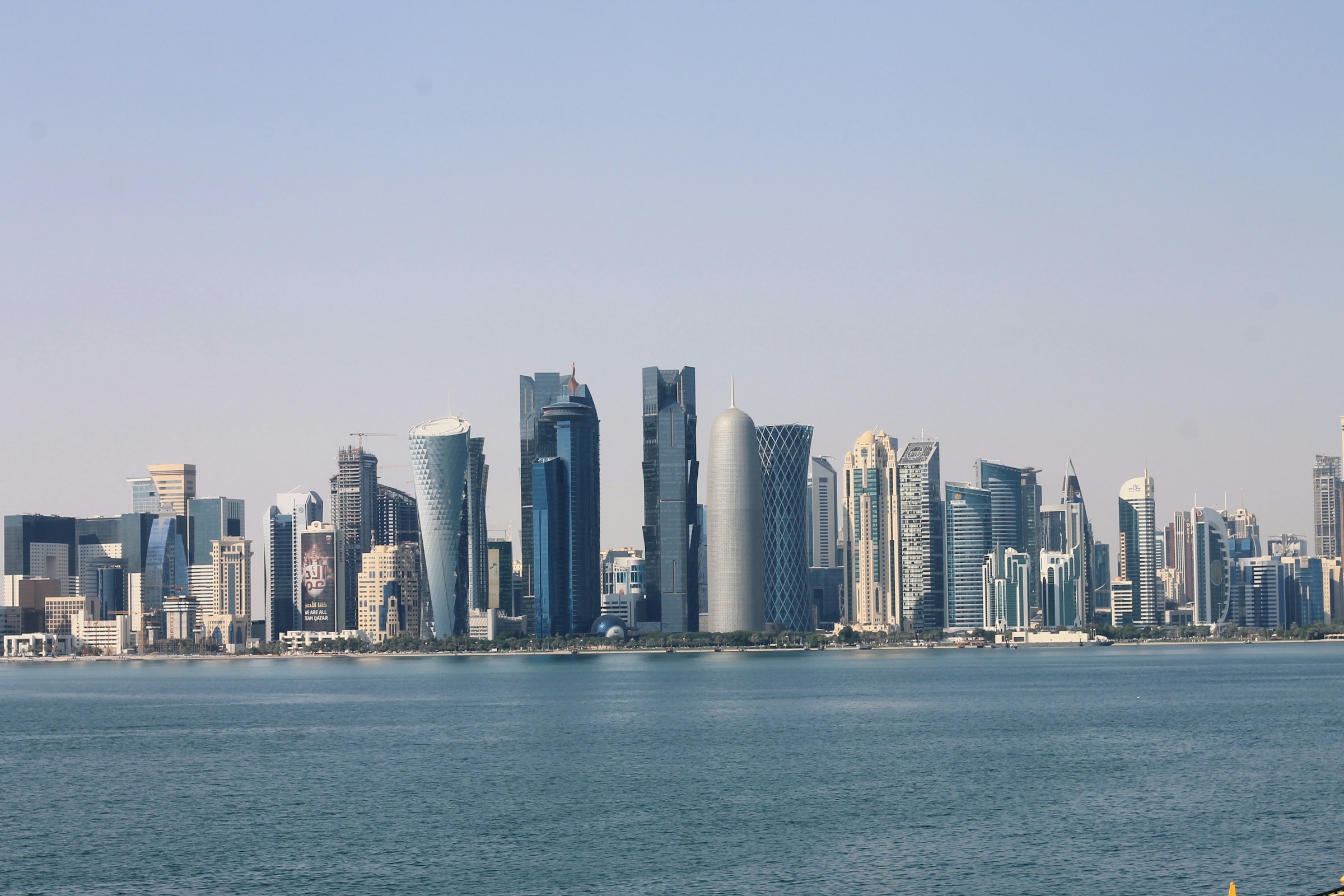
Qatar’s strongest balance sheet cannot engineer around its central chokepoint.
Qatar’s LNG system is concentrated in a way crude-export systems are not. Production, processing, and marine access converge at Ras Laffan and the Strait of Hormuz, with no land route capable of replacing the shipping corridor when it is impaired.
That physical constraint now intersects with a North Field expansion that has slipped repeatedly, a fiscal deficit running ahead of plan, and uncertainty over whether disrupted export volumes are deferred or permanently lost. Financial strength absorbs the shock; it does not remove the dependency.
Public evidence brief5 cited findings behind the assessment
Question answered
What emerging risks could change Qatar's fiscal position, and what would have to happen first?
This evidence layer is public and citable. The complete analysis, rankings, calculations, scenarios, and decision implications continue below.- Geography
- Qatar · GCC · Strait of Hormuz · Asia
- Sectors
- LNG · Public finance · Trade and logistics
- Risk classes
- Chokepoint risk · Infrastructure concentration · Fiscal risk · Contract and demand risk
- Potential impact
- Severe under a prolonged export interruption; absorbable under a short disruption
- Time horizon
- Immediate · 2026–2028
Key findings and source trail
The evidence an outside reader can verify.
- 01
Qatar's LNG exposure is a physical constraint rather than a funding constraint.
The US Energy Information Administration identifies the Strait of Hormuz as the route for roughly one-fifth of globally traded LNG. Unlike crude, LNG requires cryogenic ships and terminals, leaving Qatar without an export-scale overland substitute.
- 02
The export disruption has a documented path into national output.
The World Bank's Qatar outlook explicitly carries the hydrocarbon-disruption channel into GDP. That makes shipping access and realised LNG throughput leading indicators for the wider economy, not merely operating metrics for the energy sector.
- 03
Almost half of the planned annual deficit was used in the first quarter.
Qatar recorded a QAR 10.3 billion first-quarter deficit against a QAR 22 billion full-year plan. Hydrocarbon revenue fell from QAR 42.5 billion to QAR 32.7 billion, establishing the fiscal transmission channel before assumptions about the duration are added.
- 04
North Field delay now combines commercial and security causes.
North Field East completion has been reported moving to mid-2028, while contractor withdrawals narrow execution capacity. Commercial slippage changes the schedule; a security-driven delay can also reprice insurance, contractor participation, and counterparty terms.
- 05
Diversification reduces domestic concentration without removing the funding dependency.
Non-hydrocarbon sectors are reported at 65.5% of GDP. That is a substantial structural achievement, but much of the system was capitalised from hydrocarbon receipts, so a long export disruption can still transmit into construction, services, employment, and confidence.
Risk transmission
How the exposure reaches the decision.
- 01
A Hormuz or Ras Laffan disruption constrains LNG loadings.
- 02
Export volumes and hydrocarbon receipts fall while expansion schedules slip.
- 03
The fiscal deficit widens and counterparties revisit delivery terms.
- 04
Longer disruption reaches contractors, non-hydrocarbon activity, and workforce retention.
- 05
Qatar's balance sheet determines endurance, but cannot create an alternative LNG route.
Entities and topics
- Ras Laffan
- North Field East
- QatarEnergy
- Strait of Hormuz
- Asian LNG buyers
- Qatar budget
Saudi Arabia routed its crude around a closed Strait of Hormuz. Qatar cannot, and no amount of money changes that.
This is the single most important thing to understand about Qatari risk, and it is not a political observation. It is a physical one. Crude oil is a liquid that travels through pipes at ambient temperature, which is why Saudi Arabia was able to open the East-West Pipeline to a record 7 million barrels a day and load at Red Sea terminals when the strait closed. The bypass was expensive and it was finite, but it existed.
Liquefied natural gas has no equivalent. It moves at −162°C in purpose-built carriers, and there is no pipeline infrastructure anywhere capable of carrying it across a land corridor at export scale. A Qatari cargo either transits Hormuz or it does not ship.
That means Qatar's chokepoint exposure is structural rather than contingent. Capital cannot buy an alternative route, because the alternative route is not a matter of capital. Roughly a fifth of globally traded LNG normally passes through the strait, about 80% of Qatar's cargoes go to Asian buyers in China, Japan, South Korea and India, and every one of those cargoes transits it.
Here is what makes Qatar genuinely interesting rather than simply exposed. The state carrying this constraint also has the strongest balance sheet in the Gulf. Its fiscal breakeven is around $44.74 a barrel, projected to fall to $37.88 by 2030, roughly half Saudi Arabia's and the lowest in the bloc. A gas-heavy export profile with low production cost is a genuinely better hand than any of its neighbours hold.
So the Qatari question is not whether it can afford a bad year. It plainly can. The question is what happens when a constraint money cannot solve meets a balance sheet built to solve things with money, and the answer turns almost entirely on how long the disruption lasts.
1. Where things stand
Exports, and what the headline number hides. Commercial transit has been near-suspended since late February 2026. The 2026 export forecast is 38.7 Mt against a pre-conflict run-rate reported as roughly double that, an implied baseline near 77.4 Mt a year.
The pattern since has been partial and negotiated rather than binary, which is harder to read than a clean shutdown. Bloomberg reported Qatar quietly moving cargoes through the strait in May 2026, and bringing empty vessels back through in June to restart the shipping cycle. Partial flow is not restoration, and a trickle that persists removes the moment at which anyone is forced to revise their assumptions.
The budget, and how fast the cushion is being used. Per the register, the 2026 budget was set on $55 a barrel, with revenue of QAR 199bn, expenditure of QAR 221bn and a planned deficit of QAR 22bn. The first quarter alone delivered QAR 10.3bn of that, or $2.83bn, and 46.8% of the full-year plan in 25% of the year.
Per AGBI and Zawya reporting, hydrocarbon revenue fell from QAR 42.5bn to QAR 32.7bn, a 23.06% drop. That is the oil and gas line specifically. Press reporting of "revenue down 24%" uses a different denominator, and the two should not be conflated. Real GDP is projected to contract 5.7% in 2026, a contraction in the strongest-balance-sheet state in the region.
The expansion, and why the delays are not all the same. North Field East and South target 142 MTPA by 2030, adding 48 MTPA of new trains over an implied 94 MTPA base. Train 1 reached first LNG in November 2025.
Start-up then slipped from mid-2026 to end-2026, and after a drone attack forced an unprecedented closure of Ras Laffan it moved again to at least 2027, with NFE completion reported sliding to mid-2028. EPC contractors have withdrawn.
The two causes are different in kind and conflating them is an analytical error. The early slippage was commercial and contractual. The later slippage followed a security event. A commercial delay reprices the schedule. A security delay reprices the schedule and the insurance and the contractor pool and the counterparty terms. Only the second kind compounds, and Qatar is now permanently in the second regime.
The economy behind it. Non-hydrocarbon sectors have reached 65.5% of GDP, a real achievement, and one capitalised out of hydrocarbon receipts. Population is around 3.1 million, with expatriate counts reported at both 2.4 million and 2.9 million: a range of 77.4% to 93.5% of the total, which we carry in full because no source arbitrates between them.
2. The ten emerging risks
Ranked by how much damage the event would do. The first one sets the severity of almost everything beneath it, and it is a question about duration rather than depth, which is an unusual shape for a risk register and the defining feature of this one.
2.1 Qatar can absorb a bad year, and nobody has priced a bad decade
Qatar burned 46.8% of its full-year deficit allowance in a single quarter. The reserves cover a bad year comfortably. What has never been priced is a disruption measured in years, and every other risk here inherits its severity from that one unknown.
The fiscal arithmetic is not yet alarming, and that is precisely the trap. A state with Qatar's balance sheet can run a heavy deficit for four consecutive quarters without anything breaking. The early evidence therefore looks survivable for exactly as long as it takes the assumption underneath it to become load-bearing.
Think about what a multi-year version actually does. It is not simply four times a one-year problem. Long-term LNG contracts come up for review. Buyers who have spent two years sourcing elsewhere build relationships and infrastructure that do not unwind. Contractors who left do not return. Sovereign credit reprices on trajectory rather than level. Each of those is a permanent change triggered by a temporary event, and each becomes more likely the longer the temporary event runs.
There is no announced end. Every published Qatari revenue projection contains an implicit view on when this stops, and we could find none that states what that view is.
One caution on the reserve side, because a number is circulating that should not be. One outlet projects a five-year crisis drawing roughly $210bn from the Qatar Investment Authority, about half its estimated liquidity. That figure comes from a single low-tier source, is corroborated nowhere we could find, and should not be cited. We mention it only because it is in circulation and someone reading around this topic will encounter it.
2.2 A second strike on Ras Laffan
Ras Laffan has been closed once by drone attack. A strike causing physical damage rather than a precautionary shutdown would remove the single facility through which effectively all Qatari LNG moves. There is no second site and no partial version of losing it.
The concentration here is extreme even by the standards of this series, and it is worth being clear that it is not a planning failure. LNG economics force it. Liquefaction trains, storage tanks and loading berths are enormously capital-intensive and are built together at the largest possible scale to get unit costs down. Every major LNG exporter concentrates, and Qatar concentrates more than most because its resource is concentrated.
The result is a single point of failure with no redundancy anywhere in the system. Saudi Arabia responded to Hormuz by using a second export route. Qatar has no second route and, at Ras Laffan, no second site either.
The first closure was unprecedented and it was resolved. Nothing about that establishes a ceiling on what a subsequent attack could do. A liquefaction train is a considerably more delicate object than a crude loading berth. Cryogenic systems, heat exchangers and compression trains have repair timelines measured in many months, and specialist replacement equipment is not held in inventory anywhere.
No source found assesses the damage from the first incident or models a larger one. We are ranking this second on consequence alone.
2.3 The shortfall turns out to be destroyed volume, not deferred
A missed LNG cargo under long-term contract may become a claim, a renegotiation, or a make-up delivery later. No source found splits Qatar's 2026 shortfall between deferral and destruction, and the entire fiscal impact depends on which it is.
The 38.7 Mt forecast is being quoted widely as though its meaning were settled. It is not, and the distinction is worth more than any other number in this article.
Half a year's volume that returns as make-up cargoes in 2027 is a cash-flow timing problem. Qatar would take a bad year and recover the revenue later. The same tonnage lost to buyers who found alternative suppliers and stayed with them is permanent revenue destruction. The two outcomes differ by the full value of the gas, and both are consistent with the published export figure.
Long-term contracts are what make this genuinely ambiguous rather than merely unknown. They are designed to survive interruption, which is why the volume does not simply vanish. They also contain renegotiation and force-majeure provisions, which is why it does not simply return.
This sits underneath every revenue projection being published about Qatar, including the ones in this article. We are carrying the same unresolved assumption as everyone else. The difference is that we are telling you it is there.
2.4 A fourth slip on North Field, with nothing running in parallel
Start-up has already moved from mid-2026 to end-2026 to at least 2027, with completion sliding to mid-2028. A fourth slip would push the expansion past the window it was designed to define, and there is no second programme to absorb it.
A single delay is a schedule. Three in sequence, arising from two different causes, is a pattern, and patterns forecast in a way individual delays do not.
The causes matter because they do not resolve together. An easing of the conflict does not restore a contractor who has already redeployed crews and equipment to another region. It does not reverse an insurance repricing that has already been written into next year's premiums. The commercial delay might unwind if conditions improve. The security-driven delay has changed the cost base underneath the programme permanently.
Everything Qatar has said about its position in the 2030s rests on this programme delivering. There is no parallel expansion, no alternative resource to develop on a similar timeline, and no capacity available to purchase elsewhere at this scale. The 48 MTPA of new trains is the entire growth story.
A fourth slip would therefore not be a schedule revision. It would be a revision to the country's forward revenue base, arriving at the same time as everything else on this list.
2.5 Re-tendering lands in a market that has already thinned
EPC contractors have withdrawn from the expansion. When those scopes are re-tendered, bids will come from a smaller pool that has already repriced the corridor for security risk, so cost and schedule rise together rather than trading off against each other.
This is usually filed as a schedule problem. It is more accurately a capability problem, and the distinction changes what can be done about it.
The number of firms in the world capable of building large LNG trains is small to begin with, this is among the most specialised heavy construction there is. The subset willing to do it in a corridor under active attack is necessarily smaller than the group that originally bid, and the reduction is not primarily about price.
Once the risk became a security risk rather than a commercial one, it stopped being something a contractor prices into a bid and became something a contractor's insurer, board and shareholders decide about. Those are different conversations with different decision-makers and different outcomes, and a higher price does not necessarily change them.
The consequence is that the normal trade-off disappears. A client can usually buy schedule with money, or save money by accepting delay. Here the same shortage drives both directions at once: the bids that do arrive will carry the security premium in the price and the caution in the programme.
2.6 Chinese demand falls while China remains the largest buyer
China is Qatar's biggest LNG customer and the most frequently cited source of demand risk against Qatari volumes. A material fall would arrive on exactly the side of the ledger the recovery is supposed to come from.
This is the same structural pattern that shows up in Saudi Arabia for crude, holding here for gas and for the same underlying reason: the counterparty that gives a producer its scale is the counterparty whose weakness it cannot hedge against. European appetite, the obvious alternative, is described as muted.
The interaction with duration is what makes it uncomfortable. A long disruption is survivable if demand is waiting on the other side of it. The volume comes back, the contracts resume, the deferred cargoes are delivered. If Chinese demand softens during the same window, the deferred volume in the third risk above has nowhere to go when transit resumes, and what looked like a timing problem becomes a volume problem permanently.
The two risks are not independent draws. They interact, and the combination is worse than either alone.
This is our read rather than a sourced forecast, and no source found puts a probability on it.
2.7 Buyers convert force majeure into permanent renegotiation
A prolonged interruption gives long-term buyers both the commercial reason and the contractual opening to reopen terms. Qatar's contracts are its principal asset, and they were written in a security environment that no longer exists.
Qatar's LNG position rests on long-dated contracts at favourable terms, secured over years when the country was the most reliable supplier in a volatile region. That reliability is exactly what the blockade has called into question, and it is priced into every one of those agreements.
The event here is not default, which would be dramatic and is unlikely. It is renegotiation, which is undramatic and is how these things actually happen: shorter tenors at renewal, destination flexibility clauses, price review triggers, or delivery guarantees that shift more risk back toward the seller. Each is individually modest. Together they would materially change the forward revenue base that Qatar's fiscal position depends on.
The timing is what makes this live rather than theoretical. Buyers negotiate hardest when a supplier has just demonstrated vulnerability, and Qatar's counterparties have spent 2026 watching exactly that.
No source found reports renegotiations underway. This is our inference from the contract structure and the circumstances rather than a documented development, and we rank it here because the asset at risk is the one the entire fiscal position rests on.
2.8 The deficit outruns its own plan for a second year
A quarter that consumed nearly half the year's deficit allowance is absorbable once. A second consecutive year at that pace turns a drawdown into a trajectory, and Qatar begins explaining its fiscal path for the first time.
The Q1 figure is not itself a crisis, and it should not be read as one. QAR 10.3bn against a planned QAR 22bn is a heavy quarter in the first quarter of a disruption with no announced end. The run-rate matters more than the level.
Qatar's breakeven of around $44.74 a barrel, the lowest in the GCC and falling toward $37.88 by 2030, is precisely why this ranks eighth rather than higher. Almost no other state in the region could absorb this. Qatar can.
The risk is what a second consecutive year does to perception rather than to solvency. Sovereign credit reprices on direction of travel, not on absolute strength, and a state that has never previously had to explain its fiscal trajectory would be doing so for the first time, to a market that has no recent experience of pricing Qatari fiscal stress.
2.9 The disruption reaches the non-hydrocarbon economy
Non-hydrocarbon sectors are 65.5% of GDP and are capitalised out of hydrocarbon receipts. A long enough LNG disruption reaches them with a lag rather than not at all.
The 65.5% figure is real and it is usually presented as evidence of risk reduction. It is partly that, and Qatar's diversification has run faster than most of its neighbours managed.
What the ratio does not capture is where the capital came from. A non-hydrocarbon sector built with hydrocarbon money is diversified in its output and undiversified in its funding, and it is the funding side that matters when receipts stop. Construction, real estate, financial services and government services in Qatar all trace back through public investment to gas revenue.
So the correct reading is not that diversification fails. It is that diversification buys time rather than immunity. The lag is the entire benefit, and a lag is a schedule, not a shield.
Whether that lag is one year or three is our question rather than a published finding, and it is the single most useful thing anyone could establish about Qatar's position. It would convert the duration question in the first risk from an unknown into a number.
2.10 The expatriate workforce leaves faster than it can be replaced
Between 77.4% and 93.5% of Qatar's population is expatriate. A sustained disruption that reduces project activity and perceived security could trigger an outflow that happens far more quickly than it can be reversed.
Per the sources found, the dependency is the highest kind there is, and the counts do not agree: 2.4 million in one source and 2.9 million in another, against a population of around 3.1 million. We carry both because no arbiter exists, and anyone quoting a single figure is choosing one silently.
The mechanism runs through the expansion programme rather than through sentiment. Contractors withdrawing and projects slipping directly reduce demand for the workforce those projects brought into the country. An expatriate labour force responds to that far faster than a national one can, because the workers have somewhere else to be and no reason to wait.
Rebuilding is much slower than losing. Skilled project labour that leaves during a disruption does not return on the announcement of a restart. It returns when contracts are signed and mobilisation is funded, which is a year or more later. That lengthens the recovery from every other risk on this list, and it means the cost of the disruption keeps accruing after the disruption ends.
No source found models this for Qatar specifically, which is why it ranks last rather than higher. The dependency itself is not in dispute.
3. What this means
The exposure is physical, not financial. This is the opposite of the Saudi position, where the binding constraints are permission and manufacturing lead times, things money and diplomacy can eventually move. Qatar's constraint is a law of matter, and the strongest balance sheet in the Gulf does not touch it.
Almost everything is downstream of duration. The first risk is not merely first. It sets the severity of the deferred-volume question, the expansion slippage and the reach into the non-hydrocarbon economy. A register treating these as independent draws overstates the number of risks and understates the size of the one.
The compounding has already started and it is not in the fiscal numbers. The reclassification from commercial to security risk has thinned the contractor pool, repriced insurance and changed counterparty terms simultaneously. None of that shows up in a deficit figure, and all of it lengthens the recovery.
What to watch. Three things would move this assessment: any disclosure splitting the 2026 shortfall between deferred and destroyed volume, the North Field start-up date holding or slipping again, and evidence of contract renegotiation with Asian buyers. The first is the number that would settle most of this article.
Sources
- authoritative · US EIA — Hormuz and LNG transit — the strait's share of globally traded LNG
- authoritative · World Bank — Qatar Macro Poverty Outlook — the hydrocarbon-disruption channel into GDP
- researched · CSIS — The Battle for Hormuz Will Reshape the Global LNG Market — why the chokepoint reads differently for LNG than for crude
- researched · AGBI — Qatar budget deficit nears $3bn as revenue drops — Q1 2026 deficit; hydrocarbon revenue QAR 42.5bn to QAR 32.7bn. ⚠ its "24%" headline and the 23.06% computed here use different bases
- researched · Zawya — Qatar budget deficit as oil and gas revenue drops — independent corroboration of the Q1 figures
- researched · MEES — NFE completion pushed back to mid-2028 — expansion schedule
- researched · Gas Outlook — North Field expansion delayed as EPC contractors pull out — contractor withdrawal
- researched · Energy Aspects — why Hormuz recovery will be slow and uneven — the recovery profile
- researched · Gulf Times / Oxford Business Group — non-hydrocarbon sectors near two-thirds of GDP — the 65.5% share
- scaffold · In-session arithmetic — the 23.06% revenue drop, the QAR 22bn budget identity, the 46.8% quarter-share, the 48 and 94 MTPA expansion figures, the 77.4 Mt implied baseline, and the 77.4%/93.5% expatriate band. ⚠ not an external source; the China-exposure and diversification-lag readings in §2.8 and §2.9 are ours, not any source's
Continue the thread
Get the next material change, not the next headline.
Receive new UFOQ briefings and concise signal updates when the evidence changes enough to matter.