The Hormuz closure reaches food through sulphur, not oil
Six months into the Strait of Hormuz closure, the input transmitting the shock to food is sulphur — a waste product nobody can make more of, and fertiliser's irreplaceable feedstock.
- Horizon
- Immediate · 2026–2040
- Signal strength
- High · observed mechanism, inferred food outcome
- Decision lens
- Food security · Fertiliser · Critical materials
- Reading time
- 10 minutes
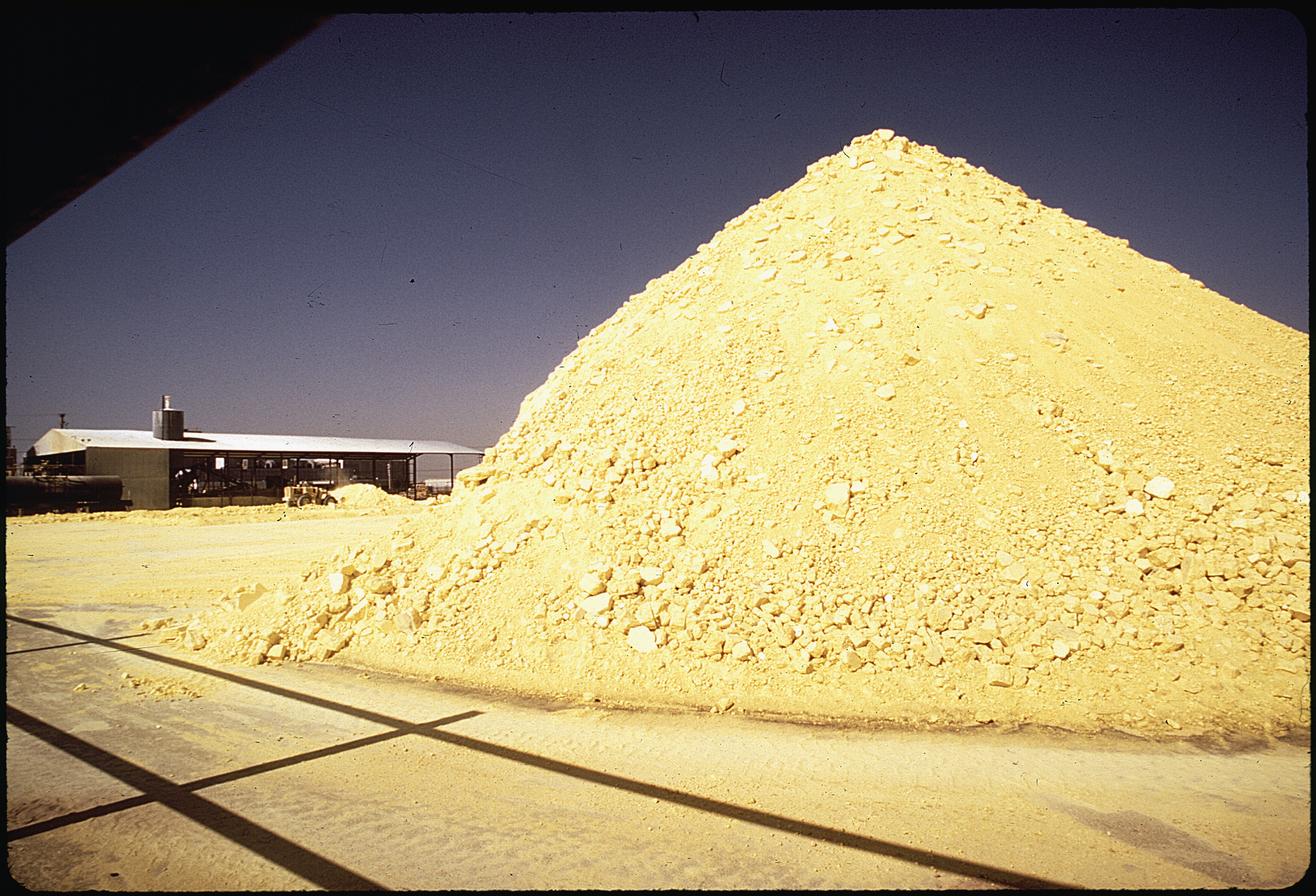
The Strait of Hormuz closure reaches food through an input with neither a normal supply response nor a satisfactory substitute: sulphur.
Sulphur is recovered as a by-product of oil and gas processing, then converted into the sulphuric acid used to make phosphate fertiliser. That means a disruption to Gulf refining and shipping can constrain an agricultural input even when phosphate rock itself remains available.
The immediate risk is a competition for scarce acid between fertiliser and metal-processing demand. The longer-term risk runs in the opposite direction: decarbonisation reduces by-product sulphur supply while agriculture and the energy transition increase demand for sulphuric acid.
Public evidence brief5 cited findings behind the assessment
Question answered
Why does closing the Strait of Hormuz raise food prices?
This evidence layer is public and citable. The complete analysis, rankings, calculations, scenarios, and decision implications continue below.- Geography
- Strait of Hormuz · Middle East Gulf · China · Indonesia · Global
- Sectors
- Phosphate fertiliser · Agriculture and food · Oil and gas processing · Copper and nickel processing
- Risk classes
- Maritime chokepoint risk · By-product supply risk · Input competition · Food-price transmission
- Potential impact
- Severe if sulphur and sulphuric-acid constraints persist into fertiliser buying and planting windows, with effects spreading from phosphate output into crop yields and food prices
- Time horizon
- Immediate · 2026–2040
Key findings and source trail
The evidence an outside reader can verify.
- 01
Sulphur supply is tied to processing other commodities, not to the sulphur price.
The USGS lists petroleum refineries, natural-gas-processing plants, and coking plants as the principal recovery routes. This makes sulphur an involuntary by-product whose supply response depends on fossil-fuel throughput.
- 02
The normal substitution valve is weak.
USGS states that substitutes for sulphur at present or anticipated price levels are not satisfactory, so high prices cannot readily push users toward another feedstock.
- 03
The Hormuz disruption is already recognised as a fertiliser and food shock, not only an energy shock.
The World Economic Forum's May 2026 outlook describes disrupted energy, food, and fertiliser flows and warns that the food-price effect can arrive gradually if fertiliser shortages persist.
- 04
Fertiliser and metal processing are competing for the same constrained molecule.
Kpler traces sulphur and sulphuric-acid flows into fertiliser, copper SX-EW, and Indonesian HPAL nickel, showing how disruption in one feedstock market reaches several downstream sectors at once.
- 05
Decarbonisation creates a structural sulphuric-acid gap after the shipping shock ends.
Open-access research led by UCL projects demand rising from more than 246 million tonnes to over 400 million tonnes by 2040, while reduced fossil-fuel processing creates an annual shortfall of 100–320 million tonnes under the modelled scenarios.
Risk transmission
How the exposure reaches the decision.
- 01
Hormuz disruption constrains Gulf sulphur shipments and nearby refining runs.
- 02
Sulphuric-acid buyers compete for an input whose output does not respond directly to price.
- 03
Industrial users can outbid or displace phosphate-fertiliser producers.
- 04
Lower fertiliser availability reaches fixed planting calendars and application rates.
- 05
Any yield effect appears later in food availability and prices.
Entities and topics
- Strait of Hormuz
- Gulf sulphur exporters
- Phosphate producers
- Chinese sulphuric-acid exporters
- Indonesian HPAL nickel plants
Closing the Strait of Hormuz raises food prices through sulphur. Sulphur is not mined; it is stripped out of sour crude and sour gas because refiners are legally required to remove it, and then sold as waste. It is also the feedstock for the sulphuric acid that dissolves phosphate rock into plant-available phosphorus. So a shipping closure in the Gulf becomes a fertiliser cost, and a fertiliser cost becomes a food price. The Strait has been effectively closed since around 1 March 2026 — 179 days as of today [computed] — and the transmission is already visible in the phosphate market.
1. Six months in, the input that reaches food is not the one being discussed
The oil story is the one that gets told. The sulphur story is the one that reaches dinner.
Sulphur is the most chokepoint-exposed material examined in this vault. According to commodity reporting via Argus Media, the Middle East is 47% of global seaborne sulphur trade, and on a second basis — share of global exports — it is around 50%. Both are carried here because no arbiter separates them: 47–50%, where the low end measures seaborne trade and the high end measures total exports. That is higher than any single-chokepoint exposure previously measured here, including aluminium's 8.03%-of-production Hormuz exposure.
One precision worth keeping. That figure is a trade denominator, not a production one. Gulf producers — Saudi Arabia, the UAE, Qatar, Iran and Kuwait — account for 20,000 kt, or 23.81% of world production [computed], and 21.31% excluding Iran [computed]. The trade share is roughly double the production share, which is the whole point: sulphur's exposure lives in the shipping lane, not in the ground.
2. Nobody produces sulphur on purpose, so a high price cannot call forth more
This is the mechanism that makes sulphur behave unlike every other commodity in this vault, and it is worth stating plainly because most readers will assume the opposite.
The US Geological Survey lists the sources "in descending order of tonnage" as petroleum refineries, natural-gas-processing plants, and coking plants. Every one of those is producing something else. Sulphur output is set by how much fossil fuel the world processes, not by what sulphur sells for. When the price triples, no producer can respond, because there is no producer — only refiners with a by-product they are obliged to remove.
The circularity is sharper than it first appears. The facilities that would produce more sulphur in response to a price spike are refineries, and in a Hormuz closure the refineries closest to the sulphur are the ones that cannot get crude to run.
The proof is in the production data. World output was 84,000 kt in 2025 against 83,900 kt in 2024 — a rise of 0.12% [computed] on USGS figures. Against price moves measured in multiples, supply moved by roughly a tenth of one percent. That single comparison is the argument of this piece.
The USGS goes further than flat output. It declines to publish a reserves table for sulphur at all — the only such case among the materials in this vault — explaining instead that because most sulphur production results from processing fossil fuels, supplies are expected to be adequate for the foreseeable future. That reasoning is sound in the long run and useless in a closure. Adequate global supply does not help a phosphate plant that cannot get a cargo.
3. There is no substitute, which removes the last escape valve
Most materials absorb a shock somewhere. Sulphur absorbs it nowhere.
The USGS position is unusually flat for a technical document: substitutes for sulphur at present or anticipated price levels are not satisfactory. Compare aluminium, which has a substitute in practically every end use, or copper, where aluminium takes share in transmission when the price runs. Sulphur has neither a supply response nor a demand escape.
A material with no reserve constraint, no supply response and no substitute is a different risk object from a mined commodity, and it should not be modelled like one.
4. Prices have moved in multiples, but the bases do not blend
Sulphur has repriced more violently than any material in this vault, and it also has the messiest price data, so the bases are kept apart here rather than averaged.
The Kuwait Sulphur Price was set at $950 per tonne fob for July 2026, up 18.0% in a single month from $805 [computed]. China was assessed at $1,330.41 per tonne in June 2026. Against the 2024 US average unit value of $46.42 per tonne, those are 20.5× and 28.7× respectively [computed] — but that multiple is not a like-for-like comparison, because the US figure is a producer netback at the plant gate and the others are delivered market assessments. The direction is unambiguous; the multiple is an artefact of mixing bases and should not be quoted as a single number.
These assessments come from price-reporting aggregators and were not verified against a price-reporting agency subscription. The move is real and corroborated across quotes; the precise levels are second-hand.
5. China halted sulphuric acid exports, layering a second chokepoint on the first
The Gulf closure would be serious alone. It is not alone.
China has suspended sulphuric acid exports, according to reporting via Exiger, SunSirs and Supply Chain Digital. China is 22.62% of world sulphur production [computed] and the dominant supplier of the acid itself. So the largest single producer closed its own export valve during a period when the largest trade route was already shut.
That is the part that turns a regional shipping event into a global one. A buyer displaced from Gulf supply would ordinarily bid for Chinese acid. In 2026, that substitution is unavailable, and the displaced demand lands instead on whatever non-Gulf, non-Chinese supply exists — raising the price for every buyer, including those with no Gulf exposure at all.
6. Food and battery metals are bidding for the same molecule, and neither can stop
Sulphuric acid has two large demand streams, and the collision between them is the mechanism that carries this into food.
More than 55% of global sulphuric acid consumption is fertiliser manufacture, on Kpler's value-chain analysis — converting phosphate rock into phosphoric acid and ammonium phosphates. The buyers are the world's phosphate producers: OCP in Morocco, Mosaic, Ma'aden and PhosAgro. That demand is seasonal and close to inelastic, because a planting window does not move.
The competing stream is metal leaching — copper SX-EW, and high-pressure acid leach nickel in Indonesia, which reportedly imports roughly 75–80% of its sulphur from the Middle East Gulf. That figure is single-sourced and materially affects this section; it should be corroborated before anything is built on it.
Indonesian HPAL cannot bid rationally, and that is what makes the competition so sharp. Industry reporting describes HPAL plants as having no partial output mode — they are on or off. A plant that cannot throttle must either secure acid at whatever price clears or shut down entirely, which means it will outbid a fertiliser producer that has the option to curtail.
And curtail is what fertiliser producers are reportedly doing. Reporting already describes phosphate producers cutting production as industrial buyers outbid them for limited sulphur. That is the food channel opening, and it is happening now rather than in prospect.
7. The long-run problem is the inverse of the short-run one
The closure will end. The structural problem it exposed will not, and it runs the other way.
According to research led by Maslin and colleagues at UCL, sulphuric acid demand rises from 246 Mt to 400 Mt by 2040, an increase of 62.6% [computed], against a projected annual supply gap of 100–320 Mt — equal to 40.7–130.1% of current supply [computed; the paper states 40–130%]. The paper itself was not read for this piece; the figures come from UCL and Royal Geographical Society summaries.
The mechanism is an unwelcome irony. Decarbonisation reduces the volume of fossil fuel processed, which reduces the sulphur stripped out as waste — while the green transition raises acid demand, because the metals in batteries are leached with sulphuric acid. Cutting fossil fuel use cuts the supply of the input the energy transition needs most. Today's shortage is a shipping event; tomorrow's is arithmetic.
8. The emerging risk: fertiliser scarcity reaching the planting season
Everything above describes the situation. What follows is the risk that may follow from it, and it is marked accordingly, because a source establishing the situation does not establish the risk.
The risk, stated as a chain [scaffold]: Gulf sulphur supply stays constrained → phosphate producers continue curtailing as industrial buyers outbid them → fertiliser availability falls going into a planting season → application rates drop → yields fall → food prices rise a season later.
Links one and two are observed and sourced: the closure is live and the curtailments are reported. Links three through six are `scaffold` — an inference from the mechanism, not a measured outcome. No source in this vault verifies that a yield reduction or a food-price rise has occurred, and none should be cited as if it had. The World Economic Forum's Chief Economists Outlook of May 2026 describes the fertiliser channel as a delayed second shock that is under-priced, which is corroboration that the channel is recognised — not evidence that the outcome has arrived.
What makes this worth flagging early is the shape of the lag rather than the size of the shock. Fertiliser demand is fixed to a calendar. A phosphate producer that curtails in August cannot make it up in November, because the crop that needed the fertiliser will already have been planted without it. The disruption is therefore invisible in food prices for months and then not recoverable within the season — which is precisely the profile that gets under-priced.
What would change this assessment. Hormuz reopening would resolve the trade constraint but not China's export halt. Confirmation of the Indonesian 75–80% dependence would raise confidence in the competition mechanism; refutation would weaken it materially. And an FAO food price index move attributable to phosphate availability would convert links three through six from inference to observation. Until then, this is a well-evidenced mechanism with an unverified endpoint, and it should be carried that way.
Sources
- authoritative · USGS — Mineral Commodity Summaries 2026, Sulfur — world production by country (84,000 kt 2025; 83,900 kt 2024), recovery routes in descending order of tonnage, the substitutes statement, and the reserves paragraph that declines to tabulate reserves
- authoritative · maritime chokepoints and auto logistics — roughly half of global seaborne sulphur trade through Hormuz; Saudi East–West pipeline capacity
- authoritative · wef chief economists outlook 2026 05 — the live Hormuz closure, and the fertiliser channel described as the under-priced delayed second shock
- researched · Middle East at 47% of global seaborne sulphur trade — via Argus Media and commodity aggregators, 2026. Argus was not fetched directly. Carried here as a 47–50% range against the export-share basis, with the basis named at each end
- researched · Kuwait Sulphur Price July 2026 ($950/t fob, +$145 on June); China June 2026 assessment ($1,330.41/t) — via price-reporting aggregators. Not verified against a price-reporting agency subscription
- researched · China's suspension of sulphuric acid exports — via Exiger, SunSirs and Supply Chain Digital
- researched · Fertiliser at more than 55% of global sulphuric acid consumption; HPAL's on/off operating characteristic; Indonesian HPAL sourcing 75–80% of sulphur from the Middle East Gulf — via Kpler's June 2026 value-chain analysis and trade press. The 75–80% figure is single-sourced and materially affects section 6
- researched · Reported phosphate production curtailments as industrial buyers outbid fertiliser producers
- researched · Maslin et al. (UCL), Sulfur: a potential resource crisis that could stifle green technology and threaten food security as the world decarbonises, The Geographical Journal, 2022 — via UCL and Royal Geographical Society summaries. The paper itself was not read; figures come from the institutional summaries
- scaffold · The transmission from phosphate curtailment through yields to food prices (section 8). An inference from the mechanism; no source verifies the outcome
- scaffold · The shared no-partial-output characteristic of HPAL plants and aluminium potlines. Seeded by [[aluminium]] section 4; no source treats these as one class, and the inference that they should be modelled together is ours
- scaffold · In-session arithmetic, 2026-08-27 — 179 days of closure from ~1 March 2026 · +0.12% world output (84,000 kt against 83,900 kt) · 18.0% one-month Kuwait price move · 20.5× and 28.7× against the 2024 US unit value of $46.42/t · 23.81% and 21.31% Gulf production shares · 22.62% China production share · 62.6% acid demand growth to 2040 · 40.7–130.1% supply gap. Not an external source
Continue the thread
Get the next material change, not the next headline.
Receive new UFOQ briefings and concise signal updates when the evidence changes enough to matter.